
Guides
Home Loan Documents Checklist: Salaried, Self-Employed, Business Owner and NRI
What each kind of applicant is asked for, which property papers the lender checks, and which items to start collecting first because they depend on other people.
Home loan paperwork falls into four groups: who you are, where you live, what you earn, and what you are buying. Every lender asks for all four. What changes between lenders — and much more between a salaried applicant and a business owner — is how much proof each group needs.
This checklist covers the documents that come up in most applications, split by the kind of applicant you are. Treat it as a way to get a head start on collecting paperwork, not as one lender's final list: the exact set is confirmed by the lender once your application is underway.
The short answer: every applicant needs identity, address and age proof, six months of bank statements and the property papers. What changes is the income proof — salary slips and Form 16 if you are salaried, two to three years of returns and financials if you are self-employed, and passport, visa and attested overseas documents if you are an NRI. Download the printable checklist (PDF).
| Document | Salaried | Self-employed | NRI |
|---|---|---|---|
| Identity and address proof | Yes | Yes | Yes, plus overseas address proof |
| PAN | Yes | Yes | Yes |
| Passport and valid visa | Not usually | Not usually | Yes |
| Salary slips | Last 3 months | Not applicable | Overseas slips, often attested |
| Form 16 | Usually 2 years | Not applicable | Where it exists |
| Income tax returns | Often 2 years | 2–3 years with computation | Indian and overseas, where applicable |
| Audited financials | Not applicable | Yes, where they apply | Where self-employed abroad |
| Bank statements | 6 months, salary account | 6–12 months, business and personal | Overseas account plus NRE/NRO |
| Employment or business proof | Appointment letter or ID card | Registration, licence, GST | Employment contract, often attested |
| Power of attorney | No | No | Usually, for signing in India |
| Property documents | Yes | Yes | Yes |
The exact years and months vary between lenders and can change over time, so treat the table as the usual shape of a request rather than a rule.
Documents required for a home loan application
Whatever your income type, these are asked for in almost every application, from each applicant and co-applicant on the loan:
- Completed application form with photographs, signed by every applicant.
- Identity proof — a government-issued photo ID. PAN is required separately for the tax record, so keep it to hand even where another ID is accepted.
- Address proof — a government-issued document showing your current residential address. If where you live now differs from the address on your ID, expect to prove both.
- Age proof, which the tenure calculation depends on, since tenure is usually limited by your remaining working years.
- Bank statements for your main account, typically covering the last six months.
- Property documents for the home being bought, financed or constructed — covered in its own section below.
A co-applicant supplies their own identity, address and income documents in full. Adding one is often how applicants improve eligibility, and it means a second complete set of paperwork rather than a few extra pages.
Documents required for a home loan for a salaried person
If your income is a salary, lenders can verify it from a short, standard set of documents:
- Salary slips for the recent months, usually the last three.
- Form 16 and/or income tax returns, commonly for the last two years.
- Bank statements showing the salary credited, usually for the last six months. The salary on the slip and the credit in the account are expected to match.
- Employment proof — an appointment letter, employment certificate or company ID, depending on what the lender asks for.
Two things slow down otherwise straightforward salaried applications: a salary paid in cash or into an account you are not submitting, and recent job changes. If you have switched employers in the last year, expect to be asked for documents covering the earlier role as well.
Documents required for a home loan for self-employed and business owners
If you are a self-employed professional
Self-employed professionals — doctors, chartered accountants, architects, consultants and the like — are assessed on income declared over several years rather than a monthly slip:
- Income tax returns with computation of income, typically for the last two to three years.
- Profit and loss account and balance sheet, audited or certified where that applies to you.
- Bank statements for both personal and professional accounts, usually for the last six to twelve months.
- Professional qualification and practice proof — your degree and registration or practice certificate.
- Business continuity proof, showing the practice has been running for a number of years.
Because the assessment reads across several years, consistency matters more than any single good year. Gaps between what the returns declare and what the bank statements show are the most common reason these applications stall.
If you own a business
If you own a business, the lender assesses the business as well as you. On top of the self-employed list, expect to be asked for:
- Business registration proof — incorporation or partnership documents, licences, or the registration certificate that applies to your structure.
- GST returns, where your business is registered for GST.
- Business bank statements, kept separate from your personal accounts.
- Company financial statements for the last two to three years.
- Details of existing business borrowing, including any loans where you are a personal guarantor.
Keeping business and personal banking cleanly separated makes this set far easier to assemble, and makes your personal income easier for a lender to read.
Documents required for an NRI home loan
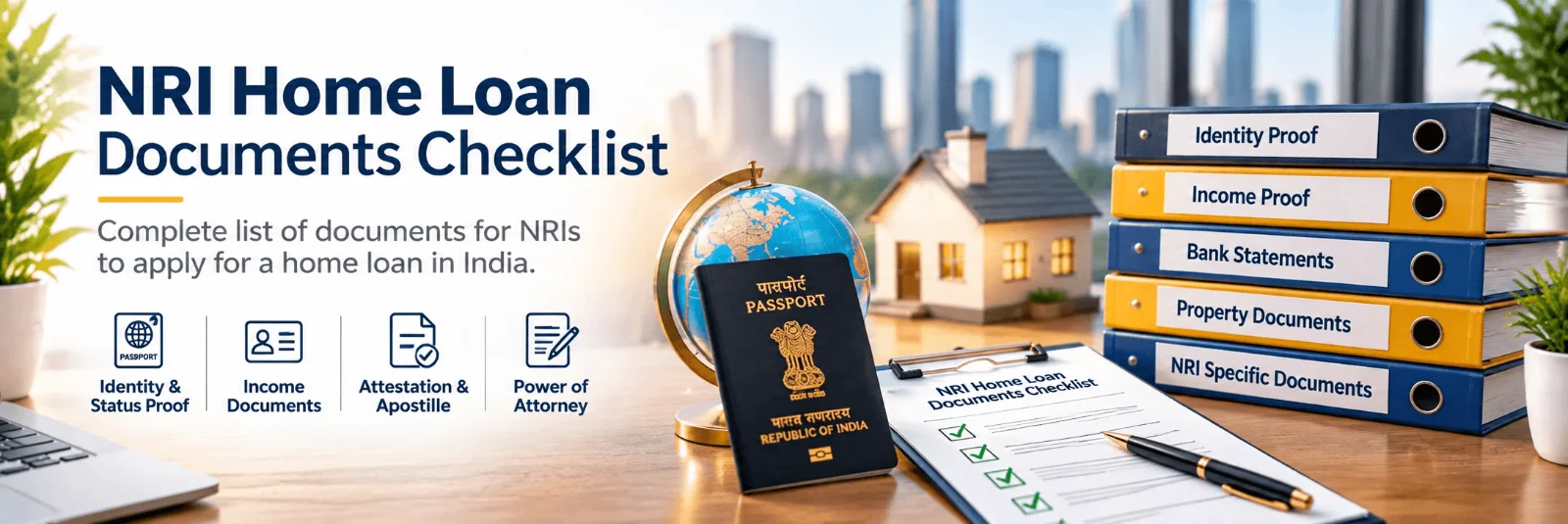
An NRI application covers the same four groups, with additional documents proving residential status and income earned abroad: passport and visa, overseas address proof, an employment contract that often needs attesting, overseas salary slips and bank statements alongside NRE or NRO statements in India, and a power of attorney for someone in India to sign on your behalf.
Attestation and the power of attorney are what usually set the timeline, because both depend on third parties abroad. There are also rules on how the purchase is funded and how the EMIs are paid that do not apply to a resident applicant at all. Our NRI home loan documents checklist covers all of it properly, including the FEMA restrictions on what an NRI may buy.
Home loan eligibility documents
It helps to separate two different jobs the paperwork does. Identity and address documents confirm who you are. A smaller set is what a lender actually assesses your eligibility from:
- Proof of income — salary slips, Form 16 or returns, depending on income type.
- Bank statements, which show income arriving and what is already committed each month.
- Existing loan and credit card statements, because current repayments reduce what you can take on.
- Credit record, which the lender pulls from the bureau rather than asking you for.
If you want a sense of the number before gathering any of this, our eligibility planner gives an indicative range from a few inputs, and the home loan EMI calculator shows what a given amount would cost each month. Both are planning models, not offers.
Property documents: resale, under-construction and leasehold
The property is the lender's security, so it is checked as carefully as you are. Which documents apply depends on what you are buying:
- Sale agreement or agreement to sell, and the allotment letter where there is one.
- Title documents establishing clear ownership, along with the chain of earlier ownership where that is relevant.
- Approved building plan and the construction or commencement permissions.
- Occupancy or completion certificate for a property that is already built.
- Encumbrance certificate, showing the property carries no undisclosed charge.
- Latest property tax receipts and, for a resale, the previous owner's paid utility bills.
- Society documents — a no-objection certificate and share certificate — for a flat in a housing society.
- Builder's demand letter, where payment is linked to construction stages.
Property documents are the most common cause of delay, and the part least within your control: they sit with a builder, a society or a previous owner. If you are early in your search, asking the seller or builder what they can provide is worth doing before you commit.
Buying a resale flat
A resale adds a history to verify. Alongside the current sale agreement, lenders look for the chain of earlier agreements back to the original allotment, the society's share certificate in the seller's name, a no-objection certificate from the society for the sale and the mortgage, and the latest property tax and maintenance receipts showing nothing is outstanding. Where the seller has an existing loan on the flat, the lender will also want that loan's outstanding statement and the list of documents the existing lender is holding, because those originals have to move from one lender to the other on the day.
Buying under construction, and what MahaRERA does and does not prove
For an under-construction purchase the lender wants the allotment letter, the builder's demand letter tied to the construction stage, the approved plan and the commencement certificate, and the project's MahaRERA registration details. Disbursement is staged against construction rather than paid in one go.
It is worth being precise about what the RERA entry tells you. Registration is a disclosure regime: it tells you the promoter has filed details of the project and lets you read them, including the sanctioned plan particulars and any complaints recorded. It is not a municipal approval, and the Bombay High Court has held that registering a project under RERA does not make an unauthorised building lawful. Check the registration on the MahaRERA portal itself and confirm the survey number matches the flat you are being sold — then check the municipal approvals separately.
CIDCO, leasehold and other restricted-tenure property
Where the land is leasehold rather than freehold — much of Navi Mumbai sits on CIDCO leasehold land, and MIDC plots work similarly — the lender needs the lease deed and, critically, the lessor's written permission to mortgage. A tripartite agreement between you, the lessor and the lender is common in these cases. The transfer permission and the NOC are usually what set the timeline rather than the lender's own assessment, so they are worth starting early. Some plots additionally need Collector permission before a mortgage can be created.
Joint home loan, co-applicant and guarantor documents
Most home loans in practice have more than one name on them, and each name brings a full document set rather than a signature.
- A co-applicant submits identity, address, age and income documents in full, exactly as the main applicant does. Their income is usually counted towards eligibility, which is why it is assessed in the same detail. Lenders generally expect co-applicants to be closely related, and most require every co-owner of the property to be a co-applicant on the loan.
- A co-owner who is not earning still signs as a co-applicant where the lender requires it, and supplies identity and address proof even though there is no income to assess.
- A guarantor, where one is asked for, supplies identity, address and income documents and signs a guarantee deed. A guarantor is liable if the borrower does not pay, and the guarantee can appear on their own credit record — worth understanding properly before agreeing to it for someone else.
- Relationship proof is sometimes requested where the lender's policy restricts who may be a co-applicant.
Collect each person's set separately and label it. A missing page is then obvious rather than buried in a single pile, and that one habit removes most second-round document requests on joint applications.
Documents for a loan against property
Borrowing against property you already own asks for the same identity and income documents, but reverses the property question: instead of proving what you are about to buy, you are proving what you already hold, free of dispute. Our guide to how a loan against property works covers how that changes the loan, and the loan against property page sets out the product itself.
Home loan documents checklist (printable)
One list to work down. Print this page, or download the checklist as a PDF — nothing to fill in and no email required.
Every applicant and co-applicant
- Completed application form with photographs
- PAN
- Identity proof (government-issued photo ID)
- Current address proof
- Age proof
- Bank statements, last 6 months
- Existing loan and credit card statements
If you are salaried
- Salary slips, last 3 months
- Form 16, usually last 2 years
- Income tax returns where asked for
- Appointment letter, employment certificate or company ID
- Documents covering a previous employer if you changed jobs within the year
If you are self-employed or own a business
- Income tax returns with computation of income, last 2–3 years
- Profit and loss account and balance sheet, audited or certified where applicable
- Bank statements, business and personal, last 6–12 months
- Business registration, licence or incorporation documents
- GST returns where registered
- Professional qualification and practice certificate, for professionals
- Details of existing business borrowing and personal guarantees
Property papers
- Sale agreement or agreement to sell, and allotment letter
- Title documents and the chain of earlier ownership
- Approved building plan and commencement certificate
- Occupancy or completion certificate, for a completed building
- Encumbrance certificate
- Latest property tax receipts
- Society NOC and share certificate, for a flat in a society
- Builder's demand letter, for a staged purchase
- Lease deed and permission to mortgage, for leasehold land
Start these first, because they depend on other people
- Society NOC and share certificate
- The existing lender's outstanding statement and list of documents, on a resale with a loan on it
- Lessor permission to mortgage, on leasehold land
- Attestation of overseas documents and the power of attorney, for an NRI application
How to get your home loan documents ready
A few habits take most of the friction out of this stage:
- Scan everything once, clearly and in full. Most document requests on a second pass are re-requests for a page that was cut off or unreadable.
- Use one bank account for income in the months before you apply, so the statements tell a simple story.
- Collect each applicant's set separately, so a co-applicant's missing page is obvious rather than buried.
- Start the slowest items first — property documents, attestations, a power of attorney — because they depend on other people.
- Check names match across ID, bank records and property papers. A spelling difference between documents is a routine but genuine cause of delay.
Frequently asked questions about home loan documents
How many documents are needed for a home loan?
There is no fixed number. A salaried applicant with one co-applicant and a ready-to-move property might submit fifteen to twenty documents in total; a business owner buying an under-construction property can submit considerably more. The count depends on how many applicants there are, your income type, and the property.
Can I apply for a home loan without Form 16?
Form 16 is one way of proving salaried income, not the only way. Where it is unavailable, lenders generally look at income tax returns, salary slips and bank statements showing the salary credited. Whether a particular lender accepts a given combination is their policy decision, so it is worth confirming before you apply.
Do co-applicants need to submit their own documents?
Yes. A co-applicant submits a full set of identity, address and income documents, just as the main applicant does. Their income usually counts towards eligibility, which is why their paperwork is assessed in the same detail.
How many months of bank statements do lenders ask for?
Six months of your main account is the usual request for a salaried applicant, and six to twelve months of both business and personal accounts where you are self-employed. The statement has to be a bank-issued one rather than a screenshot or a self-printed list, and lenders generally want it to be recent — if an application runs on for a while you may be asked for updated statements covering the intervening period. The same goes for salary slips, where the last three months is the common ask. This is typical practice rather than a rule, and it varies by lender.
Is Aadhaar enough as address proof?
Usually yes, where the address on it is the one you currently live at — Aadhaar is among the most widely accepted address proofs, and it also serves as identity proof. Two situations change the answer. If you have moved and the Aadhaar still shows the old address, expect to prove the current one separately with something like a recent utility bill, a registered rent agreement or a bank statement. And PAN is asked for in addition regardless, because it is the tax record rather than an address proof. Which documents a particular lender accepts is its own policy, so it is worth confirming before you start collecting.
What happens if a document is missing?
The application waits. Missing or unclear paperwork is the most common cause of delay, and the easiest to avoid. If a document genuinely cannot be obtained, say so early: there is often an accepted alternative, but only if the lender knows to look for one.
Are the documents the same for every lender?
The categories are broadly the same across lenders, because they are all answering the same four questions. The specifics differ — how many years of returns, which address proofs are accepted, what needs attesting — and they can change over time. Confirm the list with your lender before you start collecting.
Before you start collecting
Knowing the list is most useful once you know roughly what you are applying for. The home loan page covers eligibility, interest rates and the application process, and if you would rather have the document list confirmed for your own situation first, an advisor can go through it with you. Getting in touch is an enquiry, not a loan application.
Have a question about what you just read?
An advisor can help you apply what you just read to your own situation.
- Free for you. Our advice costs you nothing. We are paid a commission by the lender once a loan is disbursed, never by you.
- We speak English, Hindi and Marathi.