
Guides
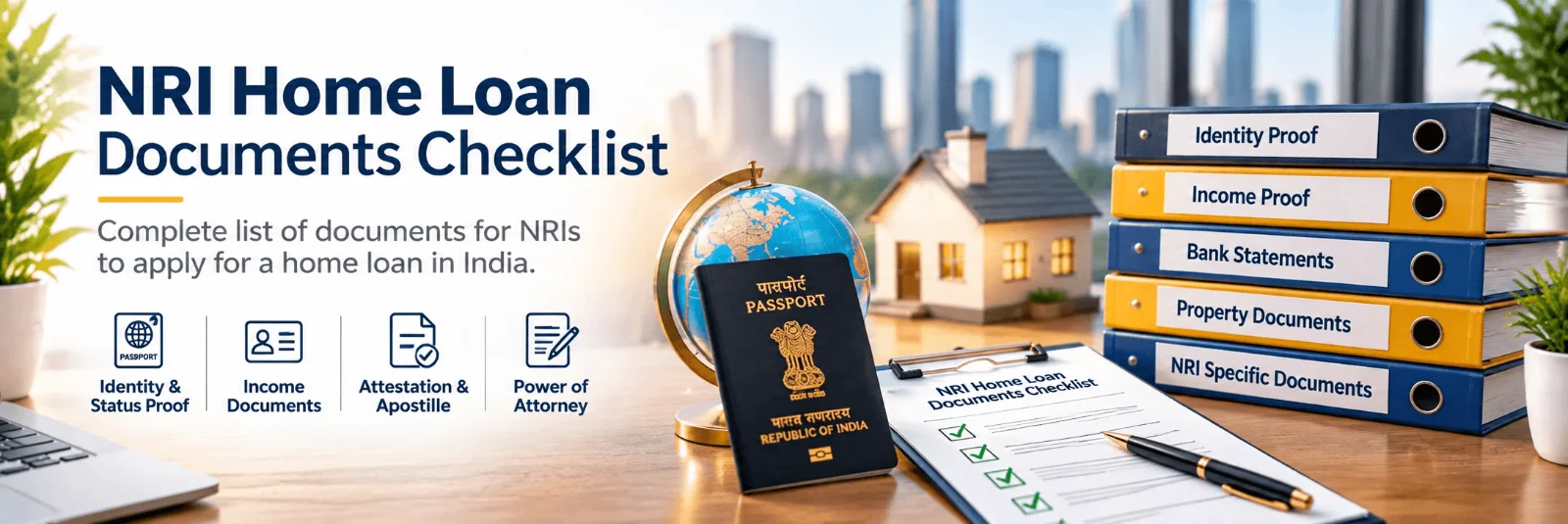
NRI Home Loan Documents Checklist
What an NRI applicant is asked for beyond the usual list — attestation, power of attorney, overseas income proof — and the FEMA rules that decide what you can buy and how you repay.
An NRI home loan is the same product a resident applicant takes, assessed against the same four questions: who you are, where you live, what you earn and what you are buying. What changes is how each one is proved. Income earned abroad has to be made legible to an Indian credit team, documents often need attesting, and somebody in India usually has to be able to sign on your behalf.
Two of those steps depend on third parties in another country, which is why NRI applications stall more often on paperwork than on income. This page sets out what is asked for, and which items to start first because they are the slow ones.
Before the documents: what you are allowed to buy
Worth settling first, because it decides whether there is a loan to arrange at all. Under FEMA, an NRI may buy residential and commercial property in India without needing RBI permission. What is not permitted without specific prior approval from the RBI is agricultural land, plantation property and farmhouses — and that restriction applies however the purchase is funded.
If a property has been described to you as "agricultural but converted", treat that as something to verify in the land record rather than accept. It is the single most expensive thing to discover late.
Identity and status documents
- Passport, with the pages showing your personal details and validity.
- Valid visa, work permit or residence permit for the country you live in. For an OCI or PIO cardholder, that card as well.
- PAN card, or Form 60 where you do not hold one.
- Overseas address proof — a utility bill, tenancy agreement or driving licence in your name.
- Indian address proof, where you retain one, along with details of a contact person in India.
- Passport-size photographs for each applicant and co-applicant.
Income documents, if you are salaried abroad
- Employment contract or appointment letter. Where the original is not in English, lenders generally want a translation, and frequently an attested one.
- Salary slips, usually for the last three to six months.
- Overseas bank statements, commonly six months, showing the salary actually arriving.
- NRE and NRO account statements in India, typically six months.
- Overseas tax returns or the local equivalent, where your country of residence issues them.
- Continuous Discharge Certificate, if you work at sea — merchant navy applicants are assessed on a different document set.
Income documents, if you are self-employed abroad
- Business registration or trade licence in the country where you operate.
- Audited financials for the last two to three years, where the jurisdiction requires them.
- Overseas personal and business bank statements, usually twelve months.
- Tax returns for the business and for you personally.
- A profile of the business — what it does, how long it has traded, who its customers are. This is read more carefully for an overseas business than a domestic one, simply because the lender cannot check it as easily.
Attestation: the step that sets your timeline
Documents issued abroad usually have to be authenticated before an Indian lender will rely on them. There are broadly two routes, and which applies depends on where you live.
- Attestation by the Indian Embassy or Consulate in your country of residence.
- Notarisation and apostille, where your country is party to the Hague Apostille Convention. The document is notarised locally, then apostilled by the designated authority.
Either way, the document then usually has to be acted on in India — adjudicated, stamped and in some cases registered — under the rules of the state where the property sits. Requirements differ between lenders and between states, so confirm the exact format with your lender before you pay for attestation. Having it done twice is a common and avoidable cost.
Power of attorney
Most lenders ask for a power of attorney appointing someone in India to sign on your behalf, because a home loan involves documents that have to be executed in person and a property transaction that cannot pause for a flight.
A few practical points. A special power of attorney, limited to this transaction, is generally preferred over a general one — both by lenders and by anyone advising you sensibly, because a general PoA grants far more than the situation needs. It is signed in your country of residence and authenticated by the same embassy or apostille route as everything else. And the person you appoint should be someone who can realistically attend offices in India at short notice.
Along with attestation, this is what most often decides how long an NRI application takes. Both are worth starting in the first week.
How the money has to move
This part is not the lender's preference, it is the rule, and it catches people out.
- The purchase must be funded through banking channels — inward remittance, or from your NRE, NRO or FCNR account. Paying in foreign currency cash is not permitted under FEMA.
- The EMIs must be paid from your Indian NRE or NRO account, or by remittance from abroad. You cannot service an Indian home loan from an overseas account directly.
- Repatriating proceeds later is where NRE and NRO differ most. Balances in NRE and FCNR accounts are freely repatriable; repatriation from an NRO account is subject to an annual limit, widely reported as USD 1 million per financial year, with tax clearance. If you expect to take money out of India again, which account you use is a decision worth taking before you buy, not after.
Terms that commonly differ from a resident loan
These vary by lender and are not rules, but the pattern is consistent enough to plan around.
- Tenure is usually shorter. Where a resident might be offered up to 30 years, NRI tenures are commonly capped somewhere between 15 and 25 years.
- Loan-to-value is typically 75–80% of the lender's valuation, so expect to fund the rest plus costs yourself.
- Age limits apply at maturity, generally in the region of 60 to 65, which is often what actually determines the tenure you are offered.
- Not every lender offers NRI loans, and among those that do, policies differ by country of residence. This is worth establishing before you assemble documents for one particular lender.
Property documents
These are the same as for any buyer, because the lender is securing against the property rather than against you. The agreement for sale, the chain of title, the approved plan and the occupation certificate all apply, and in parts of the Mumbai region there are local additions — CIDCO permission in Navi Mumbai, Collector permission on Class II land in Thane, and municipal approvals that need close checking in Kalyan and Dombivli.
What to start first
Three things depend on other people and everything else depends on you. Begin the power of attorney, the attestation of your employment and income documents, and your overseas bank statements if your bank is slow to issue certified copies. The rest — passport copies, PAN, photographs — can be done in an afternoon whenever you like.
One general caution: the specifics on this page, particularly tenure caps, repatriation limits and attestation formats, are set by regulation and by individual lender policy and do change. Treat this as a way to get a head start and to ask better questions, and confirm the current position with your lender before you rely on any of it.
If you would like this checked for your situation
Which documents you need depends on where you live, how you are paid and what you are buying, and the answer is often shorter than this page suggests. The general home loan documents checklist covers the resident case, and the home loan page sets out eligibility and the application process. If you would rather have someone go through it with you, getting in touch is an enquiry, not a loan application, and our advice costs you nothing.
Have a question about what you just read?
An advisor can help you apply what you just read to your own situation.
- Free for you. Our advice costs you nothing. We are paid a commission by the lender once a loan is disbursed, never by you.
- We speak English, Hindi and Marathi.